Water Damage Restoration in Cedar Park, TX
Cedar Park is the city directly south of Leander on US 183, and the two share a boundary that most people cross without noticing. It incorporated in 1973 with about 1,800 people and counted 77,595 in 2020, with the steepest climb between 2000 and 2010 when the population nearly doubled. The town sits at about 935 feet on limestone, and the tributaries that become Brushy Creek start in its western neighborhoods. On May 27, 1997, an F3 tornado went through the old downtown along Bell Boulevard and rebuilt a good part of it.
The housing splits by decade. Buttercup Creek, Cypress Creek, and the streets near Bell Boulevard are 1980s and 1990s one- and two-story slab homes with copper under the floor and the first generation of attic air handlers. The newer sections toward Ronald Reagan Boulevard and Parmer Lane are 2000s and 2010s two-stories with PEX and attic water heaters, the same pattern as Leander next door.
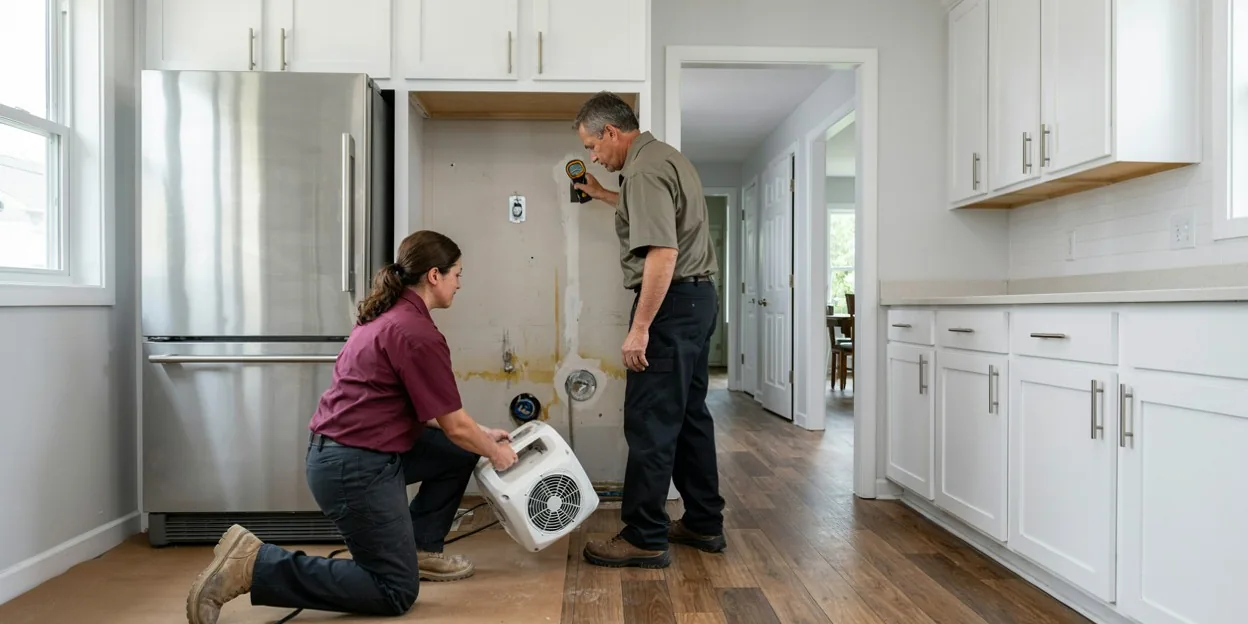
Your call reaches an independent local water damage provider serving Cedar Park by phone. The provider reads both floors with a meter before deciding anything.
Cedar Park water damage from Bell Boulevard to Parmer Lane
A hot line under a 1990s Buttercup Creek slab that shows as a warm tile and a high bill is a leak detection call. A drain pan that overflowed above a Ranch at Brushy Creek bedroom in August is ceiling water damage repair. A supply line that split in an attic during the 2021 freeze is burst pipe water damage, and the ground-floor walls get metered along with the ceiling.
Who issues the permit and who holds back the creek
Rebuild permits for plumbing, drywall, and electrical inside the city come from the City of Cedar Park, which also runs the water utility that can shut a meter at the curb. The flood-control dams on the Brushy Creek headwaters west and north of town belong to the Upper Brushy Creek Water Control and Improvement District, and its lake-level page is the one to watch when a storm stalls over the Hill Country.
Call (737) 317-2602 and describe what got wet. We route the call to an independent local water damage provider serving Cedar Park.
Services Available in Cedar Park
Water Extraction
Standing water pulled off the slab, the upstairs subfloor, and the garage in a Leander two-story, with meter readings taken before anything is cut.
Structural Drying
Dehumidifiers and air movers sized for a humid Hill Country summer, run until the drywall, the stair treads, and the cabinets read dry.
Leak Detection
A high Leander water bill, a warm tile, or a soft wall traced to a PEX fitting, a slab line, or a manifold before anyone opens the floor.
Burst Pipe Water Damage
Ceilings, walls, and floors soaked when an attic or exterior wall line split in a freeze, pumped out and dried once the valve is closed.
Flash Flood Cleanup
Creek water and street runoff pulled out of a garage or ground floor, contaminated materials removed, and the house dried afterward.
Water Heater Leak Cleanup
An attic or garage tank that let go, and the ceiling, insulation, closet, and flooring it soaked on the way down, dried and opened only where wet.
Ceiling Water Damage Repair
A stain or sag under an upstairs bath, an attic air handler, or a drain pan, metered from above before the drywall comes down.
Roof Leak Water Damage
Wet insulation, ceilings, and walls dried out after Hill Country hail or a stalled spring storm found a gap in the shingles or flashing.